

Architecture
Telium splits authority by what owns the data. An account has one authoritative home server, and a guild has one authoritative guild server. They can be the same machine, but nothing in the protocol requires it. You can sign in as @alice:home.example and join guilds hosted on guilds.example and anywhere else.
Home server
Section titled “Home server”Your home server owns account-scoped state:
- authentication, devices and passwords (OPAQUE)
- your profile, account lifecycle and identity-continuity documents
- your side of friendships and blocks
- direct-message delivery and encrypted vault material
- synced client settings (sealed on your device first)
- the list of guilds you belong to on other servers
- account migration state
It does not hold a copy of foreign guilds. Channels, messages and roles of a guild on another server stay on that server.
Guild server
Section titled “Guild server”A guild server is the only authority for a guild’s:
- channels, categories, roles, overwrites and permissions
- members, bans, timeouts and join state
- messages, reactions, pins, threads, forums, read state and search
- invites and audit log
- AutoMod, held messages and reports
- voice state and SFU authorization
There is no multi-master replication. Each permission check runs once, against one copy of the state.
Media origin
Section titled “Media origin”A media origin stores content-addressed files and issues capability-bearing references. A guild stores the reference, not another copy of the file. See Media.
The SFU forwards voice, video and screen-share media. It makes no permission decisions. The guild server decides who may join, publish, subscribe or stream, and mints a short-lived signed token with those rights. The SFU verifies the token and moves media. See Voice and video and SFU.
Connections
Section titled “Connections”A client holds one connection to its home server and one per guild server it uses. To reach a guild server, the client gets a short-lived, audience-bound identity assertion from the home server and exchanges it for a guild-local session. After that, the home server is off the guild’s hot path.
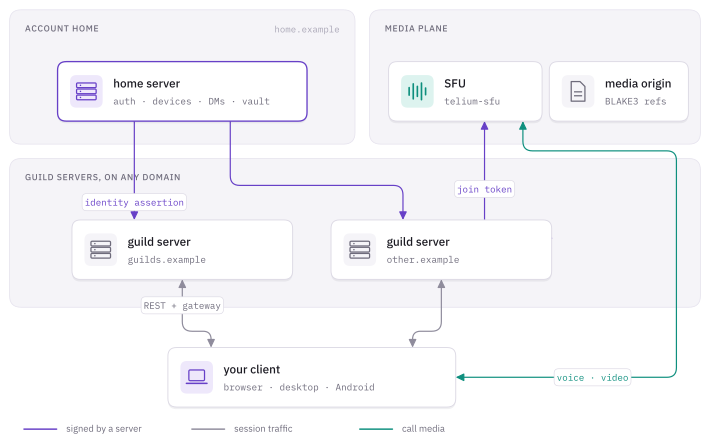
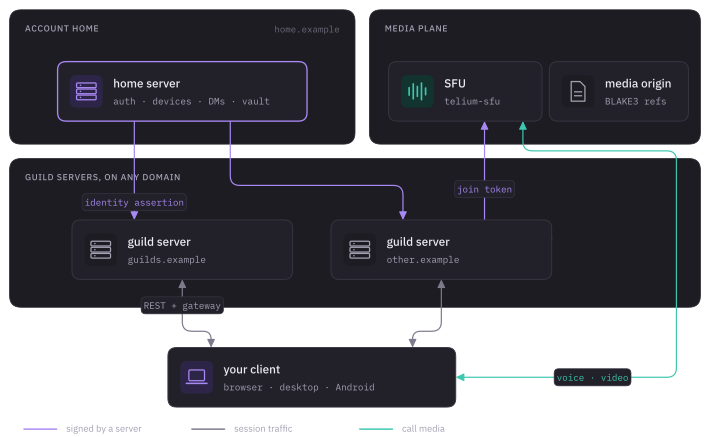
If one guild server goes down, only the guilds on it stop working. Your home server and other guilds keep running.
One process or several
Section titled “One process or several”A small deployment runs all three roles in one telium-server process on SQLite. The switches live in [roles]:
[roles]identity = trueguild = truemedia = trueA disabled role does not mount its routes. In a single process, POST /_telium/v1/sessions/local runs the same assertion and session exchange internally, so you can split roles later without changing account identity. GET /_telium/v1/capabilities tells clients which features a server offers.
Federation identity
Section titled “Federation identity”When authorization depends on which server is asking, servers sign their requests. TLS protects the transport. The Telium signature identifies the logical server that sent the request. Discovery (/.well-known/telium/server) maps a server name to its current endpoint and published keys, so a server can move hosts or fail over without changing identity. Public lookups such as profiles and keys return signed documents instead of requiring a signed request.
Details: Federation overview and Signing.
Who can read what
Section titled “Who can read what”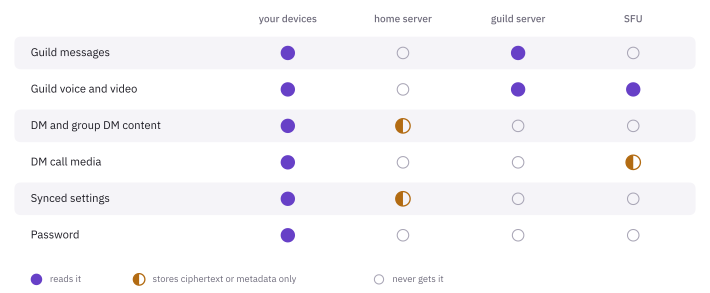
| Data | Readable by |
|---|---|
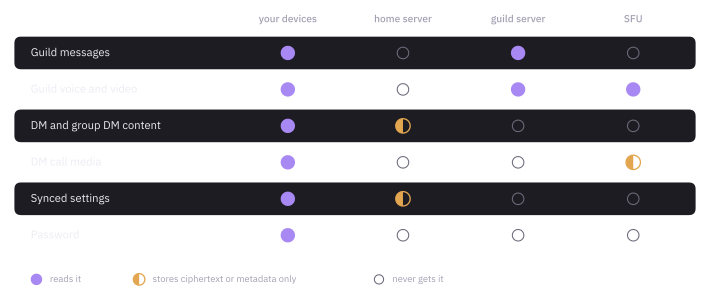
| Guild messages | The guild server |
| DM and group-conversation content | Only participants’ devices (MLS). Home servers route ciphertext and keep delivery metadata. See DM encryption. |
| Passwords | Not sent to the server as a reusable secret (OPAQUE). See Account security. |
| Media | Anyone holding its capability reference |
| Presence and activity | The audience you share it with, subject to your privacy settings |
Caches and failure
Section titled “Caches and failure”Every cache in Telium can be dropped and rebuilt from the authority: the client’s IndexedDB snapshot, foreign profiles cached by guild servers, remote media caches, federation key caches, and a warm standby’s replica.
The system expects partial failure:
- Federation deliveries queue and retry, so both servers need not be online at once.
- A warm standby serves reads and refuses writes until you promote it. See Warm standby.
- A demoted primary refuses new writes and points at the new authority.
Repository
Section titled “Repository”| Path | Contents |
|---|---|
server/ |
Reference homeserver (all three roles) |
web/ |
Shared React client and browser build |
web/electron/ |
Electron desktop shell |
web/src-tauri/ |
Tauri 2 shell for Android |
sfu/ |
Telium SFU front end and LiveKit integration |
telium-protocol/ |
Shared signing and protocol primitives |
sdk/ |
Bot SDK |
site/ |
Public website and server registry |
See Development to build and test each part, and API for the endpoint surface.